 GEMAAL OP ZUID
Programma
SD#01 Dom dom, tak dom, tak by Mohamed Abdelkarim
Spiritual Disobedience #1 Dom dom, tak dom, tak
by Mohamed Abdelkarim
In the world of One Thousand and One Nights, the ghoul inhabits the shifting boundaries between the human and the monstrous, the living and the dead. But what if the ghoul is not simply a being, but a becoming? What material histories produce ghouls?
Dom dom, tak dom, tak traces how struggles that appear defeated return in different forms and at different times. Rather than moving in a straight line, history’s violence and resistance reverberate across time, its unfinished struggles resurfacing in the present. Moments of ghoulish uprising dot our timelines which spiral in the masmoudy rhythm. Severed heads bring us to the edges of epochs, to the edges of colonial time.
Dom dom, tak dom, tak. 1800, Suleiman al-Halabi killed Jean-Baptiste Kléber, commander of the French colonial forces in Egypt. His skull was taken as an artifact and placed in French museums. Dom dom, tak dom, tak. 1695, Zumbi dos Palmares led the resistance to enslavement of Africans by the Portuguese in colonial Brazil. His body cut up, his head made a trophy, a sign of warning. Dom dom, tak dom, tak. 680, Imam Hussein, refusing to accept an unjust ruler, was killed during the battle of Karbala, the only truth that remained was his head, which created a split in time, a path to follow.
Dom dom, tak dom, tak. What is severed does not disappear. It remains as a trace, carrying memory with it. A skull. A spear. A flag. A colonial artifact, a warning to the colonized, a symbol of martyrdom and resistance. What can the remembrance of this ghoulish past mean for understanding the crises of the present? Can the absence of justice be understood as a moment of suspension within a larger rhythm, a waiting that does not mean the end?
Dom dom, tak dom, tak is the first exhibition in the Spiritual Disobedience: O Companion of Time series curated by Yusser al Obaidi.
by Mohamed Abdelkarim
In the world of One Thousand and One Nights, the ghoul inhabits the shifting boundaries between the human and the monstrous, the living and the dead. But what if the ghoul is not simply a being, but a becoming? What material histories produce ghouls?
Dom dom, tak dom, tak traces how struggles that appear defeated return in different forms and at different times. Rather than moving in a straight line, history’s violence and resistance reverberate across time, its unfinished struggles resurfacing in the present. Moments of ghoulish uprising dot our timelines which spiral in the masmoudy rhythm. Severed heads bring us to the edges of epochs, to the edges of colonial time.
Dom dom, tak dom, tak. 1800, Suleiman al-Halabi killed Jean-Baptiste Kléber, commander of the French colonial forces in Egypt. His skull was taken as an artifact and placed in French museums. Dom dom, tak dom, tak. 1695, Zumbi dos Palmares led the resistance to enslavement of Africans by the Portuguese in colonial Brazil. His body cut up, his head made a trophy, a sign of warning. Dom dom, tak dom, tak. 680, Imam Hussein, refusing to accept an unjust ruler, was killed during the battle of Karbala, the only truth that remained was his head, which created a split in time, a path to follow.
Dom dom, tak dom, tak. What is severed does not disappear. It remains as a trace, carrying memory with it. A skull. A spear. A flag. A colonial artifact, a warning to the colonized, a symbol of martyrdom and resistance. What can the remembrance of this ghoulish past mean for understanding the crises of the present? Can the absence of justice be understood as a moment of suspension within a larger rhythm, a waiting that does not mean the end?
Dom dom, tak dom, tak is the first exhibition in the Spiritual Disobedience: O Companion of Time series curated by Yusser al Obaidi.
Agenda
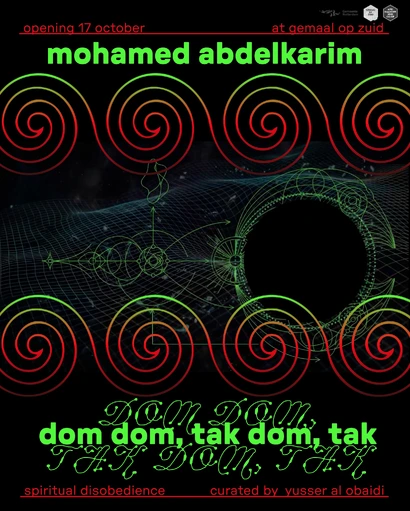
Opening exhibition SD#01 Dom dom, tak dom, tak by Mohamed Abdelkarim
Opens 17 oct
Spiritual Disobedience #1 Dom dom, tak dom, tak
by Mohamed Abdelkarim
In the world of One Thousand and One Nights, the ghoul inhabits the shifting boundaries between the human and the monstrous, the living and the dead. But what if the ghoul is not simply a being, but a becoming? What material histories produce ghouls?
Dom dom, tak dom, tak traces how struggles that appear defeated return in different forms and at different times. Rather than moving in a straight line, history’s violence and resistance reverberate across time, its unfinished struggles resurfacing in the present. Moments of ghoulish uprising dot our timelines which spiral in the masmoudy rhythm. Severed heads bring us to the edges of epochs, to the edges of colonial time.
Dom dom, tak dom, tak. 1800, Suleiman al-Halabi killed Jean-Baptiste Kléber, commander of the French colonial forces in Egypt. His skull was taken as an artifact and placed in French museums. Dom dom, tak dom, tak. 1695, Zumbi dos Palmares led the resistance to enslavement of Africans by the Portuguese in colonial Brazil. His body cut up, his head made a trophy, a sign of warning. Dom dom, tak dom, tak. 680, Imam Hussein, refusing to accept an unjust ruler, was killed during the battle of Karbala, the only truth that remained was his head, which created a split in time, a path to follow.
Dom dom, tak dom, tak. What is severed does not disappear. It remains as a trace, carrying memory with it. A skull. A spear. A flag. A colonial artifact, a warning to the colonized, a symbol of martyrdom and resistance. What can the remembrance of this ghoulish past mean for understanding the crises of the present? Can the absence of justice be understood as a moment of suspension within a larger rhythm, a waiting that does not mean the end?
Dom dom, tak dom, tak is the first exhibition in the Spiritual Disobedience: O Companion of Time series curated by Yusser al Obaidi.
Spiritual Disobedience #1 Dom dom, tak dom, tak
by Mohamed Abdelkarim
In the world of One Thousand and One Nights, the ghoul inhabits the shifting boundaries between the human and the monstrous, the living and the dead. But what if the ghoul is not simply a being, but a becoming? What material histories produce ghouls?
Dom dom, tak dom, tak traces how struggles that appear defeated return in different forms and at different times. Rather than moving in a straight line, history’s violence and resistance reverberate across time, its unfinished struggles resurfacing in the present. Moments of ghoulish uprising dot our timelines which spiral in the masmoudy rhythm. Severed heads bring us to the edges of epochs, to the edges of colonial time.
Dom dom, tak dom, tak. 1800, Suleiman al-Halabi killed Jean-Baptiste Kléber, commander of the French colonial forces in Egypt. His skull was taken as an artifact and placed in French museums. Dom dom, tak dom, tak. 1695, Zumbi dos Palmares led the resistance to enslavement of Africans by the Portuguese in colonial Brazil. His body cut up, his head made a trophy, a sign of warning. Dom dom, tak dom, tak. 680, Imam Hussein, refusing to accept an unjust ruler, was killed during the battle of Karbala, the only truth that remained was his head, which created a split in time, a path to follow.
Dom dom, tak dom, tak. What is severed does not disappear. It remains as a trace, carrying memory with it. A skull. A spear. A flag. A colonial artifact, a warning to the colonized, a symbol of martyrdom and resistance. What can the remembrance of this ghoulish past mean for understanding the crises of the present? Can the absence of justice be understood as a moment of suspension within a larger rhythm, a waiting that does not mean the end?
Dom dom, tak dom, tak is the first exhibition in the Spiritual Disobedience: O Companion of Time series curated by Yusser al Obaidi.